
This is the complete chapter wording in a single page.
Please note: The information contained in this chapter sets out good practice that should be considered by event organisers. However, it is industry guidance and does not necessarily cover everything that organisers need to consider for a particular event.
Unless public toilets are available on the site, it will be necessary to provide facilities for the comfort of both those attending and working at the event. Generally portable toilets can be rented, and suppliers can advise on the appropriate number for a specific event. Provision should also be made for cleaning and emptying toilets if the event runs over a prolonged period. As a rule, more female toilets are needed than male toilets – for a typical local event the guide is one female toilet per 100 attendees and one male toilet per 500 attendees plus one urinal per 150. At least one dedicated accessible toilet should also be provided. Hand wash or gel should also be provided.
Updated: 8 December 2025
Key Points
- Event organisers must provide suitable and sufficient sanitary and welfare facilities for workers at an event
- Responsible organisers will provide appropriate sanitary and welfare facilities for the audience
- Provision of welfare facilities for the audience has positive benefits in controlling health risks and contributing to audience wellbeing and behaviour
- Numbers of toilets depends on factors such as the size and demographics of the audience as well as the duration of the event.
- Consider the needs of those with special accessibility needs.
- Licensing legislation enforced by Local Authorities may require provision of sanitary and welfare facilities for those attending.
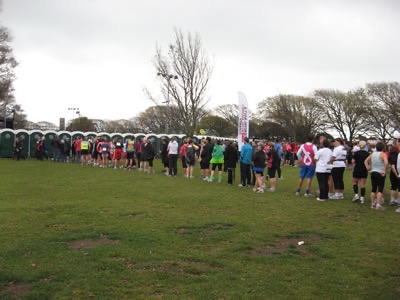
Legislation
1. The Workplace (Health, Safety, and Welfare) Regulations 1992 require that suitable and sufficient toilets and welfare facilities must be provided for employees at workplaces.
2. It is likely that separate facilities will have to be provided for food handlers (catering staff) under public entertainment licensing. For further information, see Regulation (EC) No 852/2004 of the European Parliament and of the Council of 29 April 2004 on the hygiene of foodstuffs.
3. There is no direct legal requirement to provide toilets and wash facilities for non-employees. Similarly, health and safety law does not prescribe numbers and types of toilets and wash facilities for use by an audience. However, the supply of adequate toilet and washing facilities is important in the prevention of health risks. Lack of sufficient provision may also result in crowd disorder.
4. The Equality Act 2010 will apply regarding sanitary accommodation for people with special needs.
5. The provision of a healthy drinking-water supply for the audience is primarily governed by legislation enforced by the Drinking Water Inspectorate (DWI). See Water chapter)6. In all circumstances, the scale of welfare facilities required will depend on the nature of the event, worker and audience profile, and the type of venue.
Welfare for Workers
7. Guidance on welfare facilities for workers, including the number and type of toilets and wash facilities, is set out in the Workplace Health, Safety, and Welfare) Regulation 1992 Code of Practice.
8. The provision of sanitary facilities for workers is also set out under the Construction and design Management regulations 2015 and in the Health and Safety Executives (HSE) Construction Information Sheet 59 and BS 6465-1:2006.
Welfare for the Audience
9. Consider the number and type of toilets and washing facilities as part of an assessment of needs. Key factors to consider include:
- audience size and demographics (e.g. provision of suitable facilities for children, the elderly or disabled and wheelchair users attending, who may take longer to use a facility).
- location of the event and type of venue (e.g. a stadium or greenfield site).
- type of facilities available (e.g. cubicles or urinals)
- frequency of emptying temporary toilets
- access to mains services temporary or otherwise
- perceived audience food and fluid consumption
- requirements during intervals and breaks in performance when use may peak
- requirements for campsites
- weather conditions and temperature
- plus, any other factors relevant to the event, such as the provision of non-gender specific facilities and for attendees who may require “changing places” (or high dependency) facilities.
10. Ground conditions must be considered for allowing vehicle access to manage both public and workers sanitation points. By nature, tanker lorries are large and very heavy when full but are essential where facilities are not connected to mains water or drainage.
11. It is important to assess the level of facilities required to reduce the likelihood of excessive queuing, overcrowding and possible disorder as well as unhealthy conditions.
Temporary Toilets
12. There are several different types of temporary toilet available for hire, from individual cubicles and urinals to larger blocks and trailer mounted units. The risk assessment should help to identify the type most suitable for the event.
13. Consider the likely peak usage of any toilet units and the time taken for cisterns to fill. Rapid and constant use of any toilet can cause the bowls to become unsanitary and prone to blockages.
14. Temporary mains units can be used if a sewer, drain, septic tank, or cesspool is available, provided there is an adequate water supply and sufficient water pressure available.
15. Recirculating self-contained units are not reliant on the availability of drains or water services.
16. Single self-contained portable units are versatile but are limited to a maximum number of uses before requiring servicing/emptying.
17. Trenches and latrines may be appropriate for some events. However, advice should be sought from the Environment Agency, or Scottish Environmental Protection Agency, and the Local Authority regarding the suitability of trenches at a specific event, and for any local guidelines ensuring safe and hygienic use. See National Regulations on the Safe Distance between Latrines & Waterpoints
18. Wherever non-mains units are used, provision should be made for safe and hygienic waste removal with holding-tank facilities available, if required.
Number of Temporary Toilets for the Audience
19. Organisers need to know the audience size and likely male to female ratio when determining the number of toilets required for an event. When there is insufficient information to assess this ratio, a split of male to female 50:50 should be assumed.
20. Table 1 below provides a basic guide to the number of units needed. However, an event-specific assessment of needs should be used to determine whether additional or a different balance of facilities is required. For example, an event organiser may decide to provide female and male urinals in addition to the traditional cubicles for greater speed of use and a reduction in the length of queues.
21. In other some situations (e.g. VIP areas) the minimum facilities outlined in Table 1 may not offer the premium experience such visitors would expect, and consideration should be given to increasing facilities based on assess anticipated demand and acceptable queue times.
22. Similarly, the number of accessible toilets needed should be based on the anticipated number of wheelchair users attending but care should be taken to manage these facilities to ensure only those who need to use them do so. To create a suitable wheelchair turning circle chemical accessible toilets normally have a much smaller waste holding tank which will quickly fill if not restricted to only users with a legitimate need.
23. Those stewarding accessible facilities should be trained to be aware that not all disabilities are visible to avoid potential for embarrassment.
24. Events where campsites are provided have differing requirements on ratios of urinals and WCs. This has been considered in the suggested ratios in Table 1.
25 Some events are now using urinals for both males and females. Female urinals can increase throughput and reduce queuing at temporary toilets at events where the age and profile of the audience makes it appropriate to include them. However, care should be taken to ensure that there are adequate numbers of traditional female WCs to cover those who do not find these systems acceptable.
26. Where single chemical toilets are provided with internal basins, ratios of toilets need to increase by 25% as set out in Standard BS6465 which states in section 5.3.3 “Self-Contained Toilets” – where more than two wc’s are recommended with built-in washbasins, WC provision should be increased by 25% (i.e. one additional wc per four wc’s or part thereof should be provided).
Table 1
Guidance on sanitation provision at a variety of event types when facilities provided are either toilet blocks or self-contained toilets where basins are NOT internal.
For events with a gate opening time of less than 6 hours duration
Female Toilets – 1 per 100
Male Toilets – 1 per 500
Urinals – 1 per 150
Accessible Toilets for disabled and wheelchair – 1 per 50
For events with a gate opening time of 6 hours or more, but with little or no alcohol or food served
Female Toilets – 1 per 85
Male Toilets – 1 per 425
Urinals – 1 per 125
Accessible Toilets for disabled and wheelchair – 1 per 45
For events with a gate opening time of 6 hours or more with alcohol or food served in quantity
Female Toilets – 1 per 75
Male Toilets – 1 per 400
Urinals – 1 per 100
Accessible Toilets for disabled and wheelchair – 1 per 40
For campsites at major events, swapping emphasis from urinals to wc's for males
Female Toilets – 1 per 75
Male Toilets – 1 per 150
Urinals – 1 per 250
Accessible Toilets for disabled and wheelchair – 1 per 40
Table 2
Refers to self-contained toilets with internal basins ONLY. Please note that ratios of accessible toilets are not affected by this recommendation, since their internal basin needs to be a specialist unit with a hand pump, and external units – typically with a foot pump – are unsuitable.
For events with a gate opening time of less than 6 hours duration
Female Toilets – 1 per 80
Male Toilets – 1 per 400
Urinals – 1 per 150
Accessible Toilets for disabled and wheelchair – 1 per 50
For events with a gate opening time of 6 hours or more, but with little or no alcohol or food served
Female Toilets – 1 per 68
Male Toilets – 1 per 340
Urinals – 1 per 125
Accessible Toilets for disabled and wheelchair – 1 per 45
For events with a gate opening time of 6 hours or more with alcohol or food served in quantity
Female Toilets – 1 per 60
Male Toilets – 1 per 320
Urinals – 1 per 100
Accessible Toilets for disabled and wheelchair – 1 per 40
For campsites at major events, swapping emphasis from urinals to wc's for males
Female Toilets – 1 per 60
Male Toilets – 1 per 120
Urinals – 1 per 250
Accessible Toilets for disabled and wheelchair – 1 per 40
27. Further guidance on sanitary installations can be found in BS6465-1:2006 + A1:2009 Sanitary Installations Code of practice for the Design of Sanitary Facilities and Scales of Provision of Sanitary and Associated Appliances.
Wash Facilities for the Audience
28. Hand wash basins can cause similar or even greater queuing than for WCs, especially for female toilets.
29. In mains connected toilet facilities it is advisable to provide one hand wash basin per two toilets for females, one hand wash per four toilets for males.
30. For single plastic toilet installations hand-washing facilities should be provided in the ratio of one hand wash basin per five facilities (WCs & Urinals) for females with not less than one hand-washing facility per ten toilets provided for men.
31. Consideration should be given to providing lower height wash basins where wheelchair users and/or a significant number of children are expected to attend an event and hand operated rather than foot operated pumps for wheelchair users.
32. Preference should always be given to providing warm-water hand-washing facilities and adequate supplies of suitable soap as this is the most effective means for cleaning hands.
33. Antiseptic hand wipes or bactericidal soap/gel can be provided, however organisers should be aware that these wipes may only be effective when hands are not visibly contaminated (for example, by mud).
34. Hand-washing facilities alone may not be adequate for events longer than one day, or when overnight camping is available. In these instances, consider whether to provide shower facilities, if an adequate supply of fresh water and sufficient water pressure is available.
35. In some instances, it may be appropriate to provide hand washing and/or showers even if the event is short in duration.
36. Alcohol and other gels and wipes must not be used where there is a risk of contamination by E. coli 0157. Thorough washing, ideally with hot and cold (or mixed warm) water and a good quality anti-bacterial soap, is required.
37.Anti-scald safeguards should be in place when children are using wash facilities.
Location of Toilets & Wash Facilities
37. Sanitary facilities for use by event workers should be located near to the work areas and at other key areas, such as:
- behind the stage
- near the mixer tower
- next to the catering areas
- in car parks
- adjacent to the first aid and welfare areas
- close to children’s areas.
38. Hand washing facilities should be located at a suitable distance from food handling areas.
39. Where possible, locate toilets for the audience at different points around the venue rather than concentrating in one small area. This will help to minimise queuing, which could lead to overcrowding problems.
40. In all cases, take into consideration ease of access for janitorial and waste-removal personnel and vehicles, which are essential to maintaining sanitary and hygienic facilities. This may include the need for temporary roadways and dedicated access routes, subject to the layout of the site.
41. Take into consideration people – other than the disabled and wheelchair users – who may be unable to use standard accessible toilets (including people with profound and multiple learning disabilities, motor neurone disease, multiple sclerosis and cerebral palsy, as well as older people). Consider providing “changing places” units which are becoming more widely available in the event hire market. See http://www.changing-places.org/
42. Where hand-washing facilities are supplied in the open air, consider the management of the facility to ensure that the surrounding ground does not become waterlogged, leading to localised flooding and the risk of slipping.
43. Special consideration should be given to safe access to washing facilities for the disabled and wheelchair users.
44. For those queuing to enter the event, consider placing toilets outside the perimeter of the venue (e.g. car parks, box-office queuing areas, event campsites, etc).
Installation & Maintenance
45. Event organisers should ensure that they and/or their contractors have assessed any risk to workers. Consider workplace transport, lifting operations and manual handling risks when moving temporary units.
46. Contractors and others involved in working with sanitary facilities should carry out an assessment of the risks to the health of their employees and others from exposure to hazardous chemicals and sewage under the Control of Substances Hazardous to Health Regulations (COSHH) 2002.
47. Assessments should be made available to employees and should identify the measures in place to prevent, or where this is not reasonably practicable, control these risks. Control measures may include:
- substitution with safer products
- properly selected and maintained equipment
- safe methods of work
- provision of protective equipment
- training
- suitable information and warnings